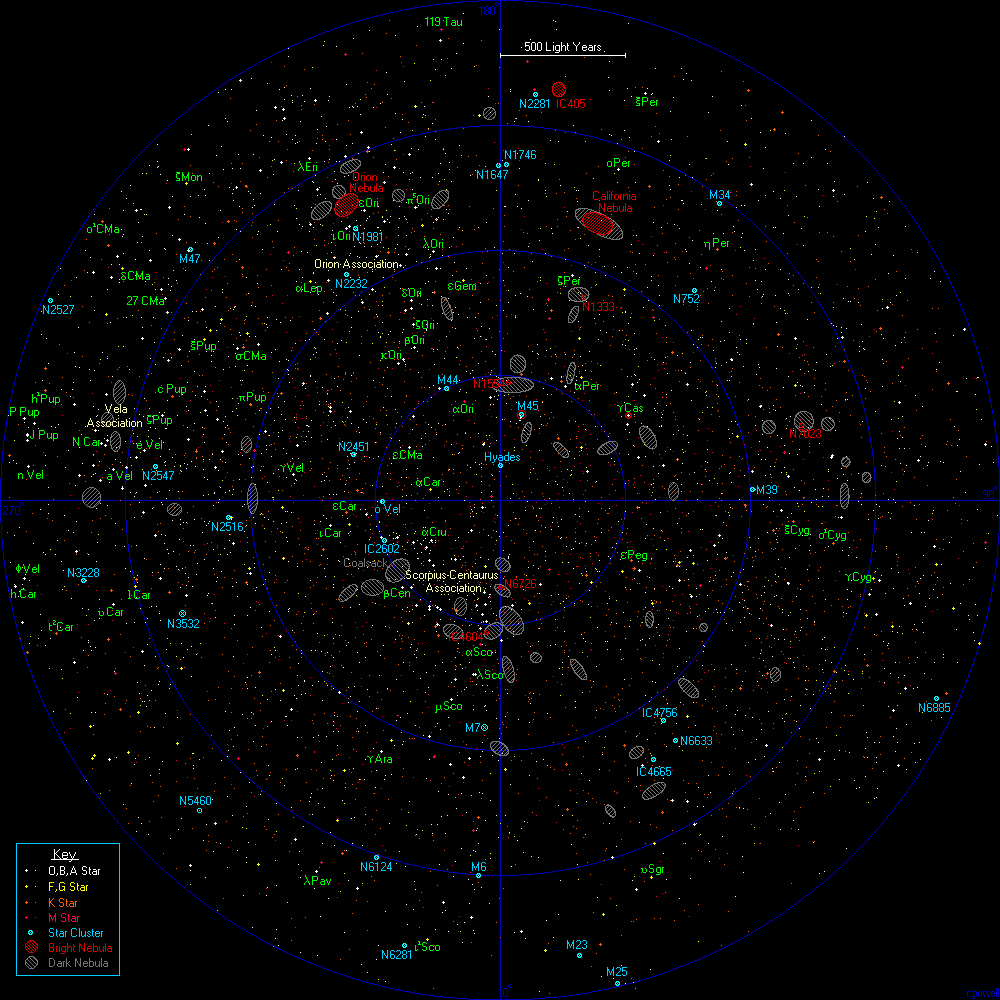
A Map of the Orion Arm within 2000 light years
This is a map of the most luminous stars within 2000 light years. Every point
on this map is an actual star listed in the Hipparcos catalog plotted onto the
galactic plane. A total of 6481 stars are plotted and every one of them is more
than a hundred times more luminous than the Sun. This is a fairly rough map
because although the Hipparcos catalog contains the most accurate star distances
available, the errors start to become large beyond 800 light years and some of
these stars may be plotted a few hundred light years from their true position.
The structure of the Orion Arm appears clearly though - the density of these
stars drops considerably towards the top and the bottom of this map, and the
three major star associations within 2000 light years are also prominant. These
are regions of hot, white stars, for example the Scorpius-Centaurus Association
contains many of the brightest stars in the constellations of Scorpius, Lupus,
Centaurus and Crux. The major star clusters and nebulae have also been plotted
onto this map.
Technical Information
This map is a plot of every star in the Hipparcos catalog with an absolute
magnitude brighter than -0.5 within 2000 light years. The 'larger' stars on the
map are the stars brighter than -2.5. All of the labeled stars are brighter
than -4. As mentioned above, the errors on the star distances beyond a thousand
light years can be several hundred light years which has made the boundaries of
the Orion Arm become very scattered.
All of the stars on the map are either young, highly luminous white stars or
older giant and supergiant stars. The total number of stars within 2000 light
years is roughly 50 million, most of which are thousands of times fainter than
the stars on the map.
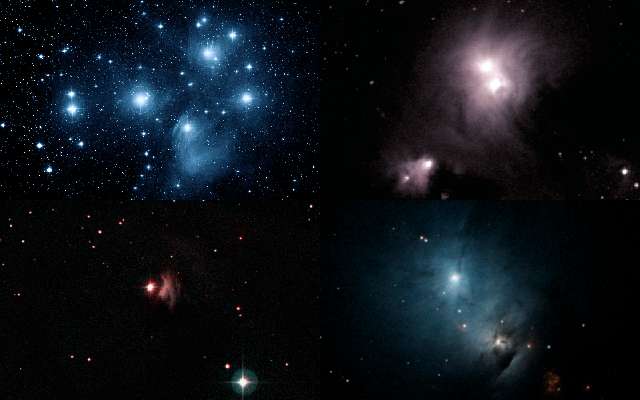
Four nearby nebulae. The Pleiades nebula (M45), top left, is probably the
nearest bright nebula, although NGC 6726/7/9, top right, lies at a similar
distance in the opposite direction. NGC 1554/5, bottom left, is a very small
part of a large dark nebula lit up by the very young star T Tauri. NGC 1333,
bottom right, is also a small part of a larger dark nebula.
 Back to the Orion Arm page