
This is a drawing of the Milky Way looking down from above. The evidence for this picture is provided below. The Sun is just one of 200 billion stars in this typical barred spiral galaxy that is about 90 000 light years in diameter.
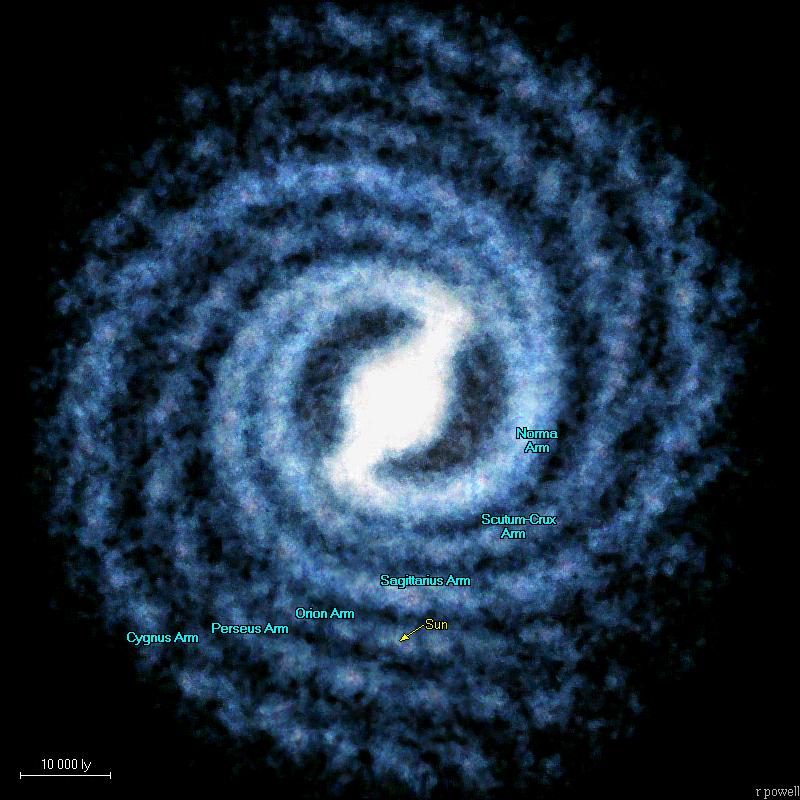
It should be emphasized that there are almost as many stars between the spiral arms as in the spiral arms. The reason why the arms of spiral galaxies are so prominant is that the brightest stars are found in the spiral arms. Spiral arms are the major regions of star formation in spiral galaxies and this is where most of the major nebulae are found.
A larger and unlabelled version of the above map is available here.
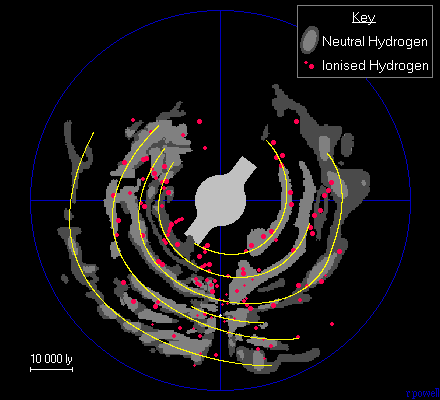
The first good map of the spiral form of the Milky Way was produced by Oort, Kerr and Westerhout in 1958 (an early version of their map exists here.) They mapped the neutral hydrogen (HI) in the plane of the Galaxy. Later, in 1976, Yvonne and Yvon Georgelin produced a map of many of the major HII regions (bright nebulae of ionised hydrogen) showing how they are distributed along the spiral arms. In 1993, Taylor and Cordes produced an updated version. In 1995, J Vallee examined the evidence and he concluded that the Galaxy was a four-arm logarithmic spiral depicted here.
It has long been suspected that the middle of the Milky Way may have a bar, but the first conclusive evidence was produced by Blitz and Spergel in 1991. Information on the exact shape of the central bar was published recently in July 2001 by López-Corredoira, Hammersley, Garzón, Cabrera-Lavers, Castro-Rodríguez, Schultheis and Mahoney, (available as a postscript file here.) They conclude that the central bar of the Milky Way looks much like the bar in the spiral galaxy M95.
If we put all this data together then we get a map like this one below. There is very little data available about the far side of the Galaxy but spiral galaxies are usually fairly symmetrical. Features on one side of a galaxy are often repeated on the other side.
| ||||||||||||||||
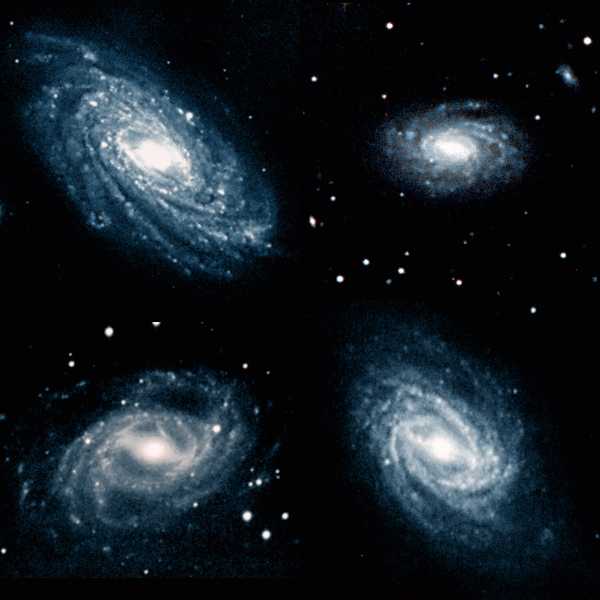
Below - four galaxies which look like the Milky Way. NGC 3953 (top left) is 55 million light years away and 95000 light years in diameter. NGC 5970 (top right) is 105 million light years away and 85000 light years in diameter. NGC 7329 (bottom left) is even further at a distance of 140 million light years but it is larger with a diameter of 140000 light years. NGC 7723 (bottom right) is 80 million light years away with a diameter of 90000 light years.
 Back to the Milky Way Galaxy page
| Top Accesses Sites on Anzwers | Top Quality Sites on Anzwers | |||
|
||||

