The Nearest Superclusters
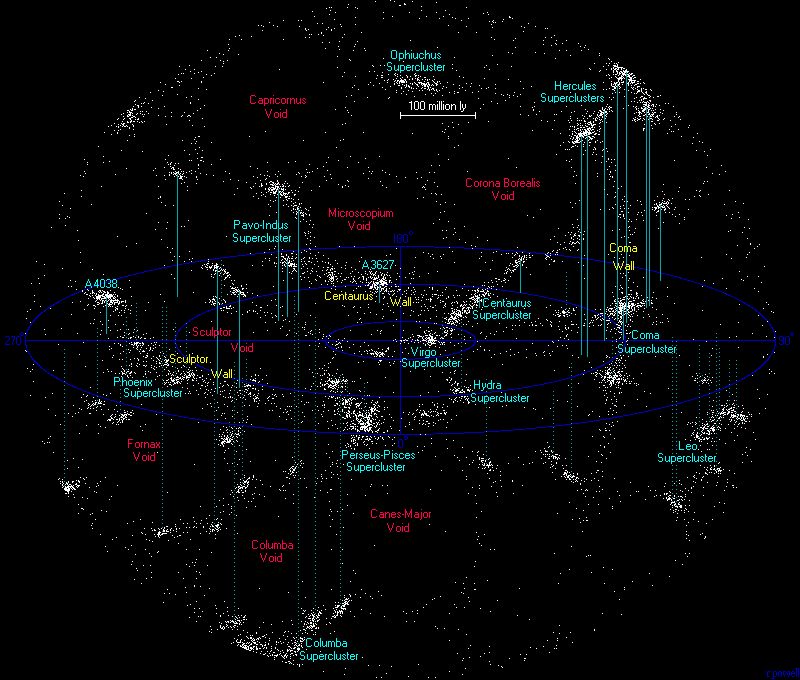
This is a map of the universe within 500 million light years. It shows most of the
major galaxy superclusters that surround the Virgo supercluster. These superclusters
are not isolated in space but together with many other smaller concentrations of
galaxies they form parts of extensive walls of galaxies surrounding large voids.
Three of the biggest walls near us are marked on the map as well as several of the
largest voids. There are several hundred thousand large galaxies within 500 million
light years so even on this scale our galaxy is a very insignificant object. There is
a negative version of this map, which might be easier to print.
A List of the Nearest Clusters
This is a list of the nearest rich clusters of galaxies listed in the Abell catalog.
These are the clusters of galaxies which contain hundreds of large galaxies. I also
added the Virgo cluster to this list - George Abell excluded it from his catalog
(because it covered too large an area of the sky to appear on a single photographic
plate.)
                    The Nearest Abell Clusters
                   ~~~~~~~~~~~~~~~~~~~~~~~~~~~~
   1       2        3      4     5    6    7        8          9
 Abell    Equatorial    Supergalactic R Redshift Distance  Supercluster
 Number   Coordinates    Coordinates               Mly     Membership
          RA       Dec	   L°    B°               (H=70)
 Virgo  12 29.6  +11 49  103.3  -2.8  1  .0035      50     Virgo
 A3526  12 48.9  -41 18  156.4 -11.4  0  .0102     142     Centaurus
 A3565  13 36.7  -33 58  151.8  -0.4  1  .0111     154     Centaurus
 A1060  10 36.9  -27 32  139.4 -37.5  1  .0114     158     Hydra
 A3627  16 15.5  -60 54  188.1  +7.1  1  .0145     201
 A3574  13 49.2  -30 18  149.2  +3.3  0  .0148     205     Centaurus
 A262   01 52.8  +36 09  335.0  -2.0  0  .0151     209     Perseus-Pisces
 A3742  21 06.7  -47 09  229.7 +20.5  0  .0152     211     Pavo-Indus
 A426   03 18.6  +41 31  347.7 -14.1  2  .0167     231     Perseus-Pisces
 A194   01 25.6  -01 30  297.1  -7.8  0  .0168     233
 A347   02 25.8  +41 52  342.8  -5.5  0  .0172     238     Perseus-Pisces
 A3656  20 00.5  -38 32  221.8 +33.6  0  .0178     246     Pavo-Indus
 A3698  20 36.0  -25 17  237.8 +42.2  1  .0188     260     Pavo-Indus
 A569   07 09.2  +48 37   29.1 -25.6  0  .0189     262
 A1367  11 44.5  +19 50   92.2 -10.5  2  .0208     288     Coma
 A779   09 19.8  +33 46   60.9 -29.7  0  .0217     300
 A3581  14 07.5  -27 01  147.6  +8.3  0  .0218     301     Centaurus
 A1656  12 59.8  +27 59   89.6  +8.2  2  .0219     303     Coma
 A2870  01 07.7  -46 55  251.0 -13.5  0  .0225     311     Phoenix
 A400   02 57.6  +06 02  312.0 -27.4  1  .0232     320
 A2877  01 09.8  -45 54  252.1 -13.8  0  .0235     324     Phoenix
 A634   08 14.6  +58 03   37.2 -14.4  0  .0253     349
 A3389  06 21.8  -64 58  211.0 -40.4  0  .0255     352
 A2666  23 50.9  +27 09  320.0 +21.1  0  .0260     358
 A2806  00 40.2  -56 10  240.9 -11.0  0  .0265     365     Phoenix
 A539   05 16.6  +06 27  336.9 -57.1  1  .0272     375
 A2199  16 28.6  +39 31   72.4 +50.2  2  .0287     395     Hercules(a)
 A2836  00 53.7  -47 37  249.9 -11.3  0  .0288     397     Phoenix
 A4038  23 47.7  -28 08  264.7  +6.8  2  .0288     397
 A2197  16 28.2  +40 54   70.5 +49.5  1  .0296     407     Hercules(a)
 A3747  21 08.7  -43 30  232.3 +23.4  0  .0298     410
 A2634  23 38.3  +27 02  319.5 +23.9  1  .0298     410
 A2731  00 10.2  -56 59  239.1  -7.2  0  .0300     413     Phoenix
 A1177  11 09.5  +21 42   87.1 -17.3  0  .0304     418     Leo
 A2896  01 18.3  -37 06  261.3 -14.0  0  .0306     421     Phoenix
 A3537  13 01.0  -32 26  148.2  -7.1  0  .0308     424
 A1016  10 27.0  +10 59   92.8 -31.1  0  .0310     426     Leo
 A2162  16 12.5  +29 32   88.9 +50.3  0  .0310     426     Hercules(a)
 A999   10 23.4  +12 51   90.4 -31.1  0  .0311     428     Leo
 A1185  11 10.8  +28 41   80.8 -13.9  1  .0313     430     Leo
 A397   02 57.0  +15 57  322.0 -23.3  0  .0315     433
 A189   01 23.7  +01 39  300.0  -6.5  1  .0316     434
 A496   04 33.6  -13 15  295.9 -55.7  1  .0317     436
 A1267  11 27.9  +26 51   84.1 -11.3  0  .0317     436     Leo
 A3390  06 25.0  -37 21  222.1 -67.4  1  .0321     441     Columba
 A1314  11 34.8  +49 02   64.5  -0.7  0  .0323     444
 A1257  11 26.1  +35 19   76.2  -8.1  0  .0332     456     Leo
 A1142  11 00.9  +10 33   97.1 -23.7  0  .0337     463     Leo
 A2052  15 16.8  +07 00  119.2 +36.0  0  .0338     464     Hercules(b)
 A2147  16 02.3  +15 54  110.0 +48.5  1  .0338     464     Hercules(b)
 A1228  11 21.5  +34 20   76.7  -9.3  1  .0340     467     Leo
 A2063  15 23.0  +08 38  117.7 +37.8  1  .0341     468     Hercules(b)
 A3193  03 58.2  -52 20  240.0 -39.5  0  .0345     474
 A3381  06 09.9  -33 36  234.0 -69.4  1  .0347     476     Columba
 A260   01 51.9  +33 10  332.1  -2.9  1  .0351     482
 A1836  14 01.7  -11 36  132.5 +12.5  0  .0351     482
 A2151  16 05.2  +17 45  107.3 +49.4  2  .0354     486     Hercules(b)
 A3570  13 46.8  -37 55  156.2  +0.2  0  .0354     486     Shapley
 A3664  20 14.0  -80 39  209.6  -6.9  1  .0357     490
 A2995  02 15.2  -24 50  275.9 -24.4  1  .0360     494
 A3575  13 52.6  -32 53  151.9  +3.1  0  .0365     501     Shapley

Column 1: The Abell catalog number of the cluster.
Column 2: The Right Ascension in hours and minutes for epoch 2000.
Column 3: The declination in degrees and minutes for epoch 2000.
Column 4: The supergalactic longitude.
Column 5: The supergalactic latitude.
Column 6: The 'richness class' of the cluster.  Roughly, this is the number of the
          very brightest galaxies in the cluster:
          0 = 30-49 galaxies, 1 = 50-79 galaxies, 2 = 80-129 galaxies.
Column 7: The redshift of the cluster relative to the cosmic microwave background.
Column 8: The distance to the cluster in millions of light years assuming that
          the Hubble constant is 70 km/s/Mpc.
Column 9: The supercluster the cluster belongs to.

References:
Abell G, Corwin H, Olowin R, (1989), A catalogue of Rich Clusters of
                Galaxies, Astrophys J Supp, 70, 1.
Struble M, Rood H, (1999), A compilation of redshifts and velocity
                dispersions for ACO clusters, Astrophys J, 125, 35.
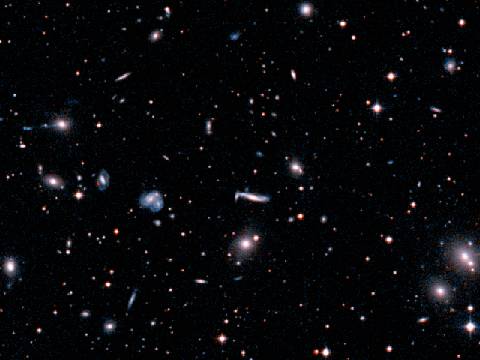
A cluster of galaxies in Hercules. This is Abell 2151, a very rich
cluster that is part of a large supercluster 500 million light years away.
 |
Recommended Reading
The best introduction to the subject of superclusters is this book 'Large-Scale
Structures in the Universe' by Anthony Fairall, (Wiley, 1998). It is an introductory
textbook which explains both the history and the future of the entire subject and also
contains many accurate (two-dimensional) maps of the distribution of galaxies in the
nearby universe. Some examples of his galaxy plots can be seen in
this paper
written by him and five colleagues in 1990. |
 Back to the Neighbouring Superclusters page