Introduction

Since
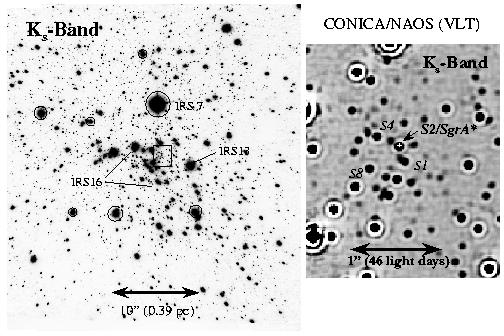
1992 we have observed the central parsec of the galactic center in K-Band.
We mainly use our Speckle-Camera SHARP I on the NTT
located at La Silla, Chile which is operated by the European Southern Observatory.
Our primary goals are to find out
- whether there is a massive black hole
- when and where the stars were born
- the nature of these stars
- the dynamics in this region
So far, we have shown that at least two periods of star formation have
occured. There are three sorts of stars in the galactic center:
- Stars with He I - emission
- Stars which show CO - absorption
- Embedded stars with featureless spectra
WARNING - The movie to the right is quite big (roughly 6MB). If you wish, you can stop the download and
download a lightweight MPEG-version.
The orbit of S2
In  Nature's 17 Oct 2002 issue
(get article) we report on having
observed 2/3 of a complete orbit of the star currently closest to the
enigmatic radio source Sagittarius A*, which is thought to mark the
location of our Milky Way's massive central black hole. As explained
below, this orbit provides overwhelming evidence that SgrA* is indeed
a supermassive black hole of more than 2 million solar masses. Figures
1,2, and 4 on this page are taken from the article in Nature. See the
star S2 swing around the black hole in this movie.
Nature's 17 Oct 2002 issue
(get article) we report on having
observed 2/3 of a complete orbit of the star currently closest to the
enigmatic radio source Sagittarius A*, which is thought to mark the
location of our Milky Way's massive central black hole. As explained
below, this orbit provides overwhelming evidence that SgrA* is indeed
a supermassive black hole of more than 2 million solar masses. Figures
1,2, and 4 on this page are taken from the article in Nature. See the
star S2 swing around the black hole in this movie.
Observations by our group and by the UCLA group
of the velocities and accelerations of stars in the
Galactic Center over the course of the last decade have already
provided strong evidence that SgrA* is in fact a black hole of about
2.6 million solar masses. However, these measurements could not rule
out some alternatives to the black hole model. Two such alternatives
are a ball of massive, degenerate fermions, like neutrinos, or a
cluster of dark astrophysical objects, such as stellar mass black
holes or neutron stars. These two alternative explanations can now be
excluded by analyzing the orbit of S2:
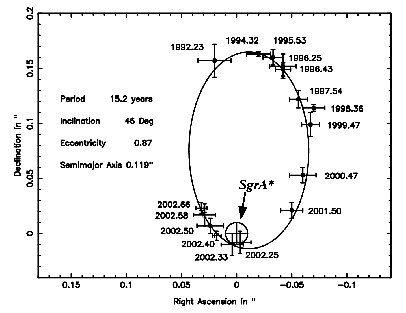
In spring 2002 S2 was passing with the extraordinary velocity of more
than 5000 km/s at a mere 17 light hours distance -- about three times
the size of our solar system -- through the perinigricon, the
point of closest approach to the black hole. By combining all
measurements of the position of S2 made between spring 1992 and summer
2002, we have obtained enough data in order to determine a unique keplerian
orbit for this star, presented in Figure 1. It is highly elliptical
(eccentricity 0.87), has a semimajor axis of 5.5 light days, a period
of 15.2 years and an inclination of 46 degrees with respect to the
plane of the sky. From Kepler's 3rd law we can determine the enclosed
mass in a straightforward manner to be 3.7±1.5 million solar
masses. Therefore at least 2.2 million solar masses have to be
enclosed in a region with a radius of 17 light hours. It is not
possible to explain this result with a neutrino ball model because the
required neutrino masses would be too large, or with a dense cluster
of dark astrophysical objects because such a cluster would have the
extremely short lifetime of at most a few hundred thousand
years. Compared to the lifetime of our Galaxy of the order of 10
billion years this configuration is highly improbable. The only
remaining alternative to the black hole model is a ball of bosons,
which would be hard to distinguish from a black hole because of its
small size. However, eventually, after some time such a ball would
eventually collapse to a black hole after having accreted enough
matter from its surroundings. Hence, the observed keplerian orbit
of S2 around SgrA* provides compelling evidence for the existence of a
massive black hole at the center of our Galaxy.
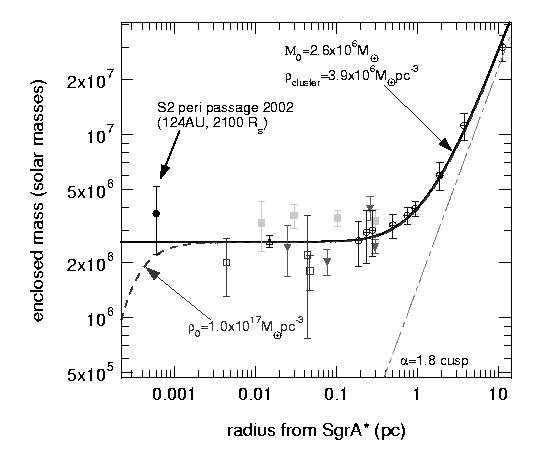
On the figure below one can see the enclosed mass derived from
different studies of gas dynamics and stellar dynamics at various
distances from the Galacic Center. The point at the shortest distance
is the mass measurement added with the aid of the newly determined
orbit. The fascinating feature of this plot is that the best fit curve
for the enclosed mass is flat inside of about 0.2 parsecs. From this
we draw the compelling conclusion that a massive black hole must be
present at the center of the Milky Way.. From the best fit
model to all the data we derive a black hole mass of 2.6±0.2
million solar masses. The long dash-short dash curve is the power-law
model for just the stellar cluster without the black hole. The dashed
curve is for a hypothetical cluster of dark astrophysical objects,
such as neutron stars or black holes, with a power-law exponent of 5
(Plummer model). Such a cluster would have a mass density higher than
1x10¹⁷Mopc-3. It's lifetime would be shorter than
about 100,000 years.
Why is this finding important to astronomers?
Over the last decades, it has become a standard paradigm that massive
black holes are located at the centers of most, if not all,
galaxies. They are believed to be the central engines powering the
enormous energy ouput and luminosity of active galactic nuclei and of
quasars, the most distant and most luminous objects observed in our
universe. Observations of other galactic nuclei have already provided
strong evidence that these massive black holes exist. However, this
evidence has always been indirect and did not exclude alternative
explanations (such as the neutrino ball model). By showing in a
direct and straightforward way that such a massive black hole does
indeed exist in the heart of our own galaxy, the Milky Way, we provide
a firm and compelling fundament for this key hypothesis of modern
astronomy.
How were these observations done?
From 1992 to 2002 we have been observing the center of our Milky Way
with the near-infrared speckle imaging camera SHARP
(developed at MPE) at the European Southern Observatory's (ESO)
NTT telescope in La Silla Chile. Speckle imaging is a special
technique in order to compensate the atmospheric turbulence and to
obtain sharp images at the theoretical diffraction limit of a
telescope despite of the degrading influence of the Earth's
atmosphere. Speckle imaging involves taking hundreds or
thousands of short exposure images of an astronomical object and the
later reconstruction of a sharp image with the aid of a computer.
Another way of compensating atmospheric turbulence is the technique of
adaptive optics. It is more costly and elaborate than speckle imaging,
but provides usually significantly better results. At the end of
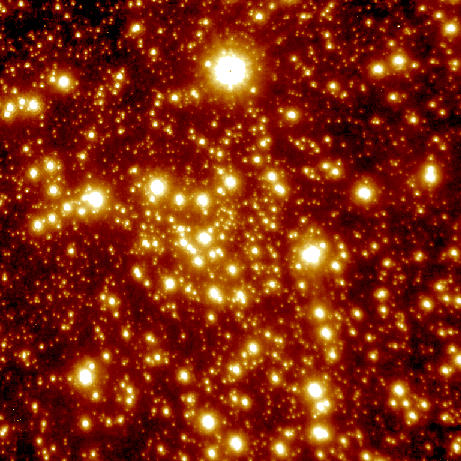
2001/beginning of 2002 the near-infrared adpative optics
system/infrared camera NAOS/CONICA was installed on one
of ESO's four 8.2 m VLT telescopes. The combination of these two new
powerful instruments porovided us with the deepest images that were
taken of the Galactic Center with an 8m-class telescope up to date
(see image).
How do we know where the black hole is?
We cannot see the massive black hole at the center of our Milky Way on
our infrared images. However, in order to examine the dynamics of the
stars in its environment it is essential to know its location on our
infrared images with a very high precision. There exists a certain
kind of stars that give off strong radiation in radio wavelengths as
well as in the near-infrared light. On the images of the Galactic
Center taken with NAOS/CONICA we can find seven of these so-called
maser stars. These stars are marked by circles in the image
below. With the knowledge of the exact position of the maser stars
relative to the black hole we can determine the pixel scale,
orientation and possible distortions of our infrared image. In this
way we obtain the accurate position for hundreds of stars relative to
the black hole for a given time.