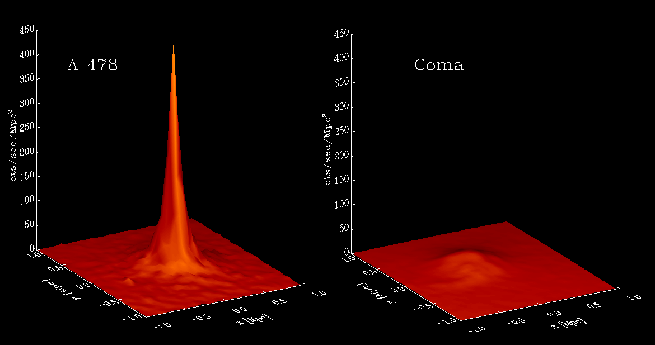
As the intracluster medium emits X-rays it cools. The X-ray emission is strongest in the centres of clusters and the cooling rate is therefore fastest there. In some clusters, the central cooling rate is so rapid that the condition of hydrostatic equilibrium leads to an inflow of material towards the cluster centre. This inflow is called a COOLING FLOW .
The presence of a cooling flow in a cluster is obvious from the X-ray data:
This figure compares the X-ray emission from a cooling-flow cluster (A478: on the left) to that from a cluster without a cooling flow (the Coma cluster: on the right). Although the luminosities of the two clusters are approximately the same - within a factor of two - the X-ray emission from the cooling flow cluster is much more peaked.
The gas in a cooling flow can be thought of as a slowly-moving emulsion of gaseous blobs with different densities and temperatures (a bit like a cosmic semolina pudding). These blobs slip slowly down the gravitational potential of the cluster (towards the centre) with the densest blobs cooling fastest. The densest blobs eventually loose all of their thermal energy and forms small, cold molecular clouds. Over millions of years the cooling flow builds up a reservoir of these cooled molecular clouds which can be seen by their absorbing effect on the X-ray spectra of the clusters.
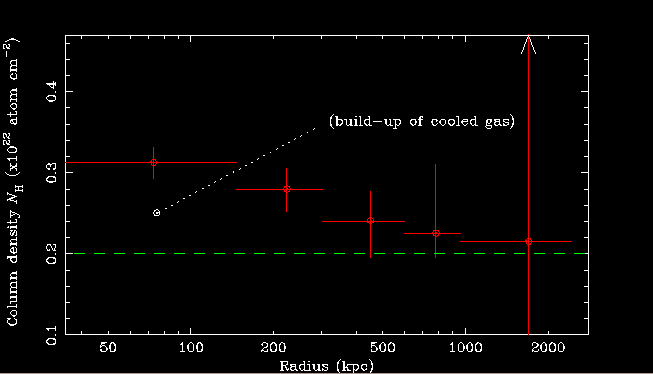
The above figure shows the build up of cooled-gas around the centre of the cluster A478.
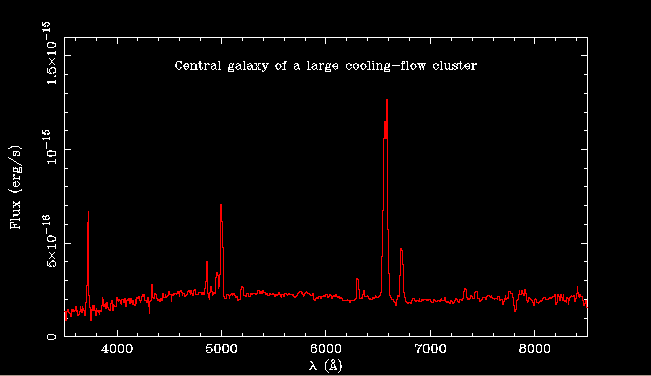
Optical spectra of giant elliptical galaxies at the centres of clusters can also show the effects of cooling flows. The figures below demonstrate the enhanced emission at short wavelengths, and the strong emission-lines often associated cooling flow galaxy. Many of these properties can be attributed to star-formation in the cooled, molecular clouds accumulated by the flows.

Click to return to the start of the clusters section.