
In any event, the strength of a gravitational field can distort light, just as a piece of glass can. The effects are actually quite similar: a strong gravitational potential increases the travel time of a ray of light, effectively boosting the index of refraction of space itself.
Europeans typicaly speak of gravitational lenses as "gravitational mirages", and this is really more accurate. In the vast majority of cases, the images produced by lensing are wildly distorted, just like a mirage, instead of clear like a focused image. This is due to the fact that the index of refraction varies irregularly rather than being determined by the carefully shaped surface of a glass lens.
Multiple images are very common, and are produced by a situation like this:
The light rays from the distant source at left are each bent by the gravitational field of an intervening massive object, like a galaxy or cluster of galaxies. When the light rays arrive here and are observed, we see them coming from a different part of the sky than they started from, so we observe "ghost" images, or mirages, at the indicated positions.
The exact number and placement of the images depend on the relative distances of lens and source, the mass of the lens, and the offset of the source from the center line. Two- and four-image systems are common with point sources like quasars, and multiple distorted arclets are typical with extended sources like galaxies. If the source is directly behind the lens, and the lens is reasonably symmetrical, the source can be smeared into a complete ring on the sky around the lens, called an Einstein ring.
So effectively our 3D mass distribution representing the lensing object behaves just like a large piece of glass, with an index of refraction varying throughout it. A relativistic problem in lensing is reduced to a classic problem of ray-tracing.
In almost all cases, we can take the thin lens approximation. The lensing effect is very weak, and the angles involved are typically millionths of a degree. Only when you magnify these angles by astronomical distances do we see these effects. In the thin lens approximation, all the mass of the lens is assumed to be projected onto a two-dimensional sheet. As long as the depth of the object is very much smaller than the distance to it, and as long as it doesn't have extremely strong mass variations across its depth, this is perfectly valid.
So by projecting the mass density onto a plane, we can reduce our 3D problem down to 2D. For various reasons discussed in the implementation section, this is not exactly what was done in this project. The operative quantity for determining the bending angles of the light is the potential gradient transverse to the light path, so in this project the potential and the gradient were calculated in 3D, and then the transverse gradient was projected onto the plane to produce the map of angular displacements. In short, this allows one to do many different projections for the computational price of a single potential solve.
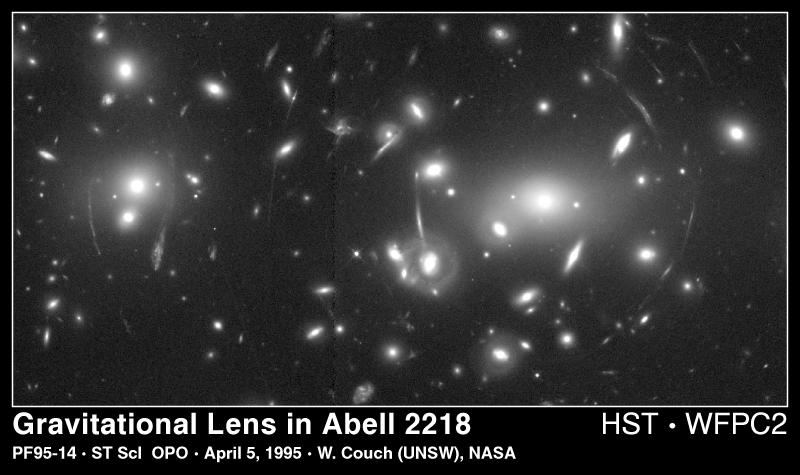
First up is the galaxy cluster Abell 2218, here imaged by the Hubble Space Telescope. All the small arclets circling around the center of the cluster are actually distorted images of background objects.
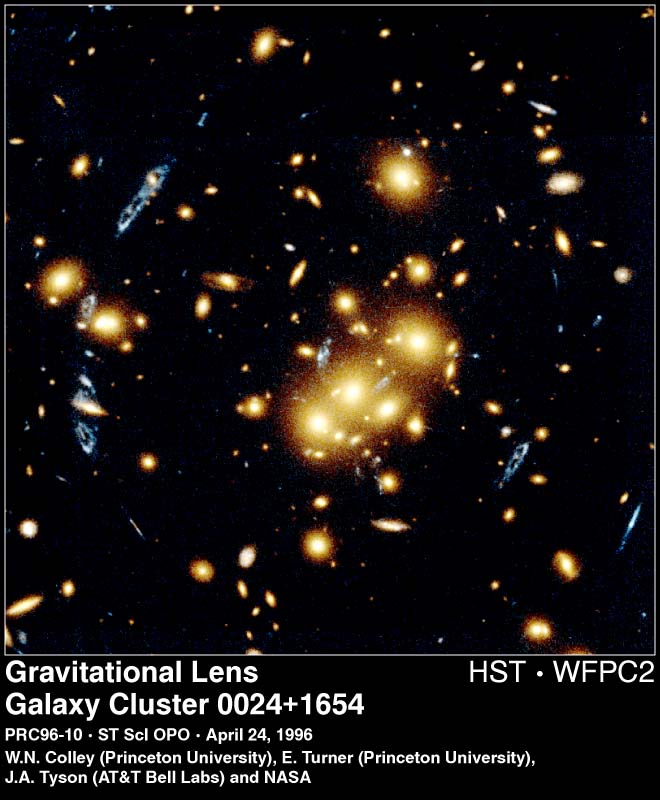
Next is the cluster 0024+1654, named merely for its coordinates in the sky. Here we see a number of distorted image arcs, but the internal structure of the background blue galaxy is also visible, and careful analysis has allowed astronomers to reconstruct the original image from the lensed copies. The background image chosen for this project's trials was specifically chosen to produce results similar to this spectacular example of gravitational lensing.
Next: the parallel implementation.
Go back to the project home page.