 |
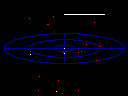
The closest star to the Sun is only 7000 times further than
the edge of our solar system. This map shows all of the stellar
systems that lie within 12.5 light years from us. |
 |
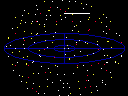 |
A large proportion of the stars visible with the naked eye are within
250 light years. This map shows this tiny section of our galaxy
that surrounds our Sun. |
|
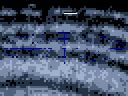 |
The local arm of our galaxy is called the Orion Arm. It is
depicted here showing the millions of stars interspersed with
clouds of interstellar gas. |
 |
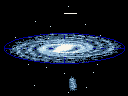 |
Our galaxy is a loose spiral disc of two hundred billion stars
rotating around a compact centre. This is a diagram showing the
main features of the Galaxy. |
|
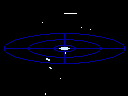 |
The Milky Way is surrounded by several dwarf galaxies slowly
orbiting it in periods of billions of years. This map shows the
nearest such satellite galaxies. |
|
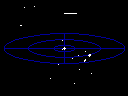 |
The Milky Way is gravitationally bound to two other large spiral
galaxies as well as dozens of dwarf galaxies. This local group
of galaxies is illustrated here. |
|
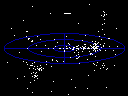 |
The local group of galaxies is just one of many centred around
the massive Virgo Cluster. Collectively, all of these groups and
clusters form a unit known as the Virgo Supercluster shown here. |
|
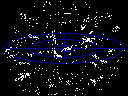 |
The distribution of galaxies in the universe is far from regular.
They tend to clump together into huge supercluster formations.
This map shows many of the superclusters within 1 billion light
years of us. |
 |
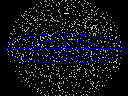 |
Although our knowledge of the large scale structure of the
universe is incomplete, many large and small scale features are
visible right out to the very edge of the visible universe. The
entire universe is fairly uniform, as this map shows. |