Number of large galaxies within 500 000 light years = 1
Number of dwarf galaxies within 500 000 light years = 9
Number of stars within 500 000 light years = 200 billion
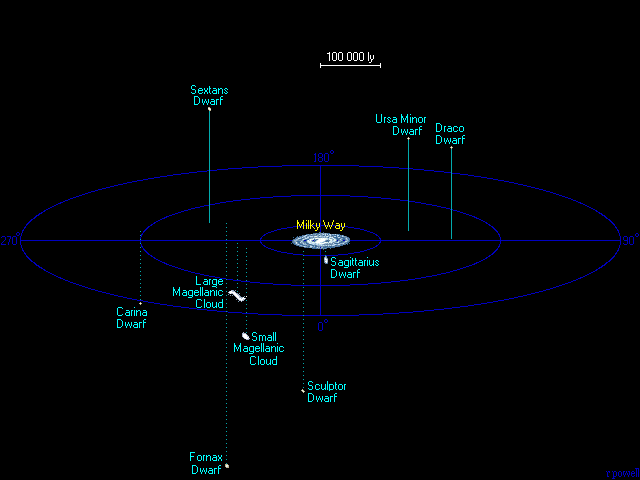
About the Map
The Milky Way is surrounded by several dwarf galaxies,
typically containing a few tens of millions of stars, which is insignificant
compared with the total stellar population of the Milky Way itself. The above map
shows all of the closest dwarf galaxies, they are all gravitationally bound to the
Milky Way taking billions of years to orbit it.
The Satellite Galaxies
Sagittarius Dwarf (Distance = 78 000 ly)
Lying on the far side of our galaxy this dwarf was discovered as recently as 1994.
It is slowly being ripped apart by our galaxy.
Large Magellanic Cloud (Distance = 170 000 ly)
The largest of the satellite galaxies and also the fourth largest galaxy in the
Local Group. This galaxy is a large bright object in southern hemisphere skies.
It contains several billion stars and many stars are still forming in it, most
notably in the Tarantula nebula, a huge concentration of gas and dust over 2000
light years in diameter. A supernova exploded in the Large Magellanic Cloud in
1987 and observations of the expanding supernova remnant provided accurate distance
measurements to the galaxy.
Small Magellanic Cloud (Distance = 210 000 ly)
Despite its name, this galaxy is fairly large for a dwarf galaxy. It contains at
least several hundred million stars and is easily visible with the naked eye from
the southern hemisphere. Like the Large Magellanic Cloud, there is still a lot star
formation taking place within it.
Ursa Minor Dwarf (Distance = 215 000 ly)
Discovered in 1954, this is a very puny galaxy. Although it is a nearby galaxy
it is far to dim to be seen with anything but a powerful telescope. All of the
stars in this galaxy are at least ten billion years old, the galaxy is too small
to allow it to hold on to gas and dust to allow any new star formation.
Sculptor Dwarf (Distance = 258 000 ly)
Discovered by Harlow Shapley in 1937. It is probably twice the size of the Ursa
Minor galaxy, but all its stars seem to be just as old.
Draco Dwarf (Distance = 267 000 ly)
Discovered at the same time as the Ursa Minor dwarf galaxy in 1954, this galaxy
is almost identical in size and consists of only very old stars.
Sextans Dwarf (Distance = 280 000 ly)
This galaxy was discovered in 1989. It is a very low luminosity galaxy but seems
to be rather bigger than the Ursa Minor and Draco galaxies.
Carina Dwarf (Distance = 330 000 ly)
Discovered in 1977, this is another tiny dwarf galaxy. However its stars are
slightly younger at about 7 billion years old than in most of the other tiny dwarf
galaxies. This galaxy seems to have formed several billion years after the other
satellite galaxies formed.
Fornax Dwarf (Distance = 450 000 ly)
Discovered at the same time as the Sculptor dwarf galaxy in 1937, it is several times
larger than the smallest dwarf galaxies and contains several million stars. Its
stars range in age from three to ten billion years old. This galaxy also has six
globular clusters orbiting it.
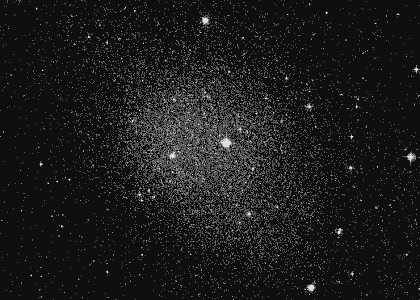
The Fornax Dwarf galaxy. Like most dwarf galaxies it
looks very unimpressive. It contains a few million stars.

 Number of large galaxies within 500 000 light years = 1